847
Abstracts scored today
2
Papers simplified (2026)
2
Retractions documented
Papers of the week

Illustration: amyloid beta plaques disrupting synaptic transmission. Generated SVG, phd.press original, CC0.
An Alzheimer's Drug That Finally Slows the Clock -- by 27%
Why it matters: Lecanemab is the first drug to show statistically significant slowing of Alzheimer's decline in a large Phase 3 trial -- small effect, real signal.
| Question | Does lecanemab slow clinical decline in early symptomatic Alzheimer's disease? |
| Sample | 1,795 adults with early Alzheimer's (MCI or mild dementia + confirmed amyloid) randomized 1:1 |
| Method | 18-month double-blind RCT; primary outcome CDR-SB (Clinical Dementia Rating sum of boxes); secondary endpoints amyloid PET, tau PET |
| Finding | Lecanemab reduced CDR-SB decline by 27% vs placebo (1.21 vs 1.66 points; p<0.001); amyloid burden fell 59.1 centiloid units vs +2.1 placebo |
| Limitation | ARIA (brain swelling/microbleeds) in 21.5% of treated patients vs 9.5% placebo; 17 serious ARIA cases in treatment arm |
| Next step | Long-term safety data; subgroup analysis in APOE4 carriers who had highest ARIA rates |
Active recall
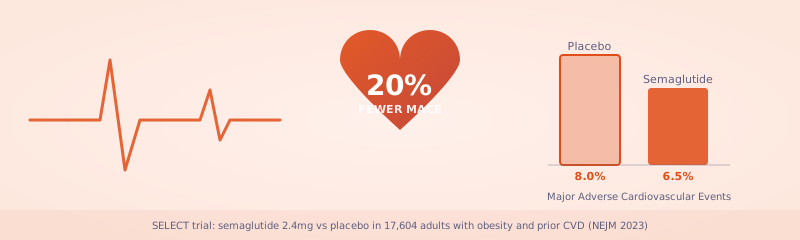
SELECT trial summary: MACE rates, semaglutide vs placebo. Generated SVG, phd.press original, CC0.
The Weight-Loss Injection That Cuts Heart Attacks Too
Why it matters: Semaglutide cut major cardiovascular events by 20% in people with obesity but no diabetes -- reframing GLP-1 drugs as cardioprotective, not just metabolic.
| Question | Does semaglutide reduce major adverse cardiovascular events (MACE) in overweight/obese adults without diabetes? |
| Sample | 17,604 adults (BMI >= 27, prior cardiovascular disease, no diabetes); randomized 1:1 to 2.4mg subcutaneous semaglutide weekly or placebo |
| Method | SELECT trial: double-blind RCT, median 34-month follow-up; primary endpoint MACE (CV death, non-fatal MI, non-fatal stroke) |
| Finding | Semaglutide reduced first MACE by 20% vs placebo (HR 0.80, 95% CI 0.72-0.90; p<0.001); mean weight loss 9.4% vs 0.88% placebo |
| Limitation | Most participants were white men; CV benefit mechanism unclear (weight loss vs direct vascular effects vs both) |
| Next step | Mechanistic sub-studies; trials in heart failure with preserved ejection fraction (HFpEF) ongoing |
Active recall
Retractions
Duplicated western blot images across 11 papers by the same PI -- three journals pull the plug
| Stated reason | Image duplication and manipulation identified by post-publication peer review (PubPeer) |
| ORI involvement | ORI investigation opened |
| Author response | Contested by corresponding author; institutional investigation ongoing |
Overlapping patient records invalidated RCT results: Lancet retracts cardiovascular trial
| Stated reason | Patient records found overlapping across two trial sites; data integrity cannot be confirmed |
| ORI involvement | None |
| Author response | Authors agreed to retraction |
The publishing system
Peer review takes 5 months on average. Most of that time is chasing reviewers, not actually reviewing.
The bottleneck in scientific publishing is not quality control. It is reviewer recruitment. Three studies from 2022 to 2024 put the average time-to-first-decision between 4.2 and 6.8 months, with reviewer recruitment accounting for 55 to 70% of that window.
| Source | Finding |
|---|---|
| Publons Global Review Report | Average 5.1 months time-to-decision across 1,300 journals (2023) |
| eLife editorial analysis | Reviewer recruitment = 58% of pre-decision delay (2022) |
| PLOS ONE internal data | Median 4.2 months; 30% of papers take 8+ months (2024) |